
CHINA’S PRESIDENT XI JINPING EMERGES AS PRESIDENT D.J. TRUMP’S PEER
- Mike Lyons
- Dec 7, 2025
- 7 min read
The Xi-Trump Phone Call

In recognition of China’s new status, Trump spoke of a “G2” with China and he resurrected the idea that the US and China, as the two superpowers would together manage global issues. If the Trump administration follows through and renounces strategic competition with China, this will mark the most fundamental shift in American strategic thinking since the end of the Cold War. The US confirmed that Trump would visit China in April 2026 and Xi would reciprocate later the same year.
Cheng Li-wun, the newly elected leader of Taiwan’s Kuomintang (KMT) which holds a plurality in the Taiwanese parliament, has taken a more pro-Beijing line than her predecessor. A potential KMT victory at the next Taiwan election in 2028 could make peaceful absorption of Taiwan by China more likely.[ii]
The US 2025 National Security Strategy (NSS)
The NSS was released by the White House on 4 December 2025 marking a profound shift in US foreign policy, focused on protecting US core national interests, namely: Homeland security, economic prosperity, and regional dominance in the Western Hemisphere.
The document is critical of the “unrealistic expectations” of European leaders for settling the war in Ukraine and proposes an expeditious cessation of hostilities in Ukraine and establishing strategic stability with Russia as a “core interest of the US” while also calling for an end to NATO expansion. The NSS casts Washington as a potential moderating force between Moscow and Europe.
The NSS also calls for an adjustment of the US global military posture so that it can put more focus on and restore America’s pre-eminence in the Western Hemisphere, at the same time, calling for increased defence spending from Japan, South Korea, Australia and Taiwan.
The document is said to layout a coherent vision of a world dominated by three big powers – the US, China and Russia which have areas of cooperation and zones of influence while downgrading China from a “pacing threat” to that of an “economic competitor” and calling for selective engagement with adversaries.[iii]
Australia’s Changing Circumstances
The global order is changing rapidly, but Australia’s foreign policy continues to be made looking into the rear-vision mirror to a more comfortable and secure world. Instead of recognising that the world order has changed profoundly, Australia has surrendered much of its sovereignty, especially by allowing long-range US bombers to be based at Tindal near Darwin and for US nuclear-powered and armed submarines to be based at Stirling near Perth. Deploying US assets at these bases has only one purpose which is to prosecute a war on China. Consequently, these bases will potentially be nuclear targets for China. NO Australian national interests can be served by this. Instead, it is about paying dues to the US in the hope that Australia will be protected by the US although that has always been a dubious proposition.[iv]
Many knowledgeable commentators question the wisdom of the AUKUS deal for Australia to buy nuclear powered submarines and Paul Keating has called it “the worst deal in all history”. Australia’s historic willingness to do whatever the US wants has seen Australia take part in pointless wars including in Iraq and Afghanistan. Many Australians see China as the principal object of concern. However, Clinton Fernandes, in his recent book, Turbulence uses the debate about “freedom of navigation” to illustrate how misguided and limited the discussion about the “China threat” really is. He points out that China, as the world’s largest trading nation is even more reliant on safe passage of its exports than is Australia and the last thing China would want is a war in the western Pacific Ocean which would disrupt nearly all of its seaborne supplies.[v]
China on the Move
Deng Xiaoping
Deng Xiaoping (1904-1997) was the chief architect of China’s reform and opening up. In January 1992, Deng is reported to have said that while “The Middle East had oil, China had rare earth elements”! He recognised that the key to achieving modernisation was the development of science and technology and, unless China gave special attention to education, it would be impossible to develop the necessary knowledge of science and technology. It has since done so on a massive scale.[vi]
Trump chose not to attend the Asia-Pacific Economic Cooperation (APEC) summit in South Korea in October 2025 while Xi took the opportunity to portray Beijing as the leading global champion of free and open trade. Standing before the 21-member APEC bloc’s leaders, Xi called for political unity and greater economic cooperation and his agenda included high-level talks with the leaders of Japan, Canada and Thailand. Earlier, a trade agreement had been signed by Trump and Xi providing for the US to lower tariffs on Chinese goods and for China to suspend its rare-earth export controls. However, the deal indicated that the US was more dependent on Chinese goodwill than vice versa.[vii]
Japan
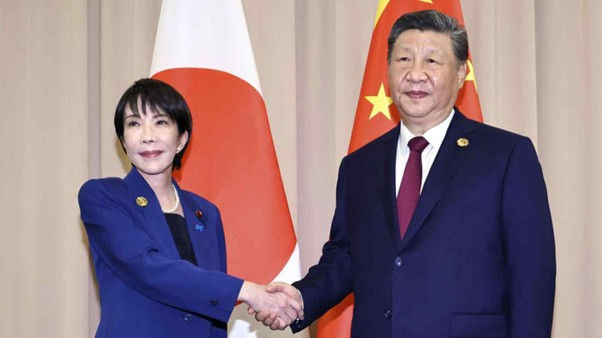
Japan’s newly elected Prime Minister, Sanae Takaichi recently said a possible attack by Beijing on Taiwan could be “survival-threatening” for Japan and Tokyo might be pushed to a military clash with China if Beijing’s aggression gave it no other choice. This resulted in an immediate downward spiral in ties between China and Japan, leading to Beijing suspending imports of Japanese seafood, advising its citizens not to travel or study in Japan (resulting in the cancellation of thousands of flights), and cutting intergovernmental exchanges.
However, several Japanese lawmakers urged Takaichi to retract her remarks urging her to return to normalisation of Japan-China relations. She has since sought to dial down tensions, referring to the 1972 commitment which led to the normalisation of ties between Beijing and Tokyo. China reiterated that Taiwan is an inalienable part of the territory of China and Takaichi said the Japanese government “fully understands and respects this stand”.[viii]
Xinjiang
Xinjiang stretches across China’s north-western region borders on eight other countries. It is located along the Silk Road which has fueled trade between the East and West for centuries. However, Xinjiang became infamous for some of the worst allegations of Chinese authoritarianism, from the detention of more than one million Uighur Muslims in “re-education camps”, to claims of crimes against humanity. Beijing has since pumped billions of dollars into Xinjiang to advance its development. The Uighurs are the largest ethnic group in Xinjiang but Han Chinese now make up 40% of the region’s population.

In recent years, Xinjiang has emerged as a tourist destination and investment has been pouring into the region. Some 200 international hotels are already operating or planning to open in Xinjiang and in 2024, the region welcomed about 300 million visitors. Although the vast majority were domestic visitors, foreign tourism is growing and an increasing number of foreigners are approaching Xinjiang with open minds and a genuine desire to see and assess the truth for themselves. Travel agencies describe the region as “exotic and mysterious” saying it offers a “magical fusion of nature and culture which you won’t experience anywhere else in China”. Xinjiang was described by a Singaporean visitor in May 2024 as “New Zealand, Switzerland and Mongolia all packed into one place”.[ix]
Thailand
Thailand’s relationship with China has entered a new phase with its King’s historic five-day state visit to Beijing in November 2025. It was the first by a reigning Thai monarch in 50 years. The King sent a strong signal to his nation that Beijing now stands at the apex of Thailand’s external partnerships. Beijing used the royal visit to express its readiness to intensify relations with Thailand and to accelerate major projects, chief among them being the China-Thailand high-speed railway. China is also Thailand’s largest trading partner.
The King’s visit showed that Thailand was open to deeper engagement with China while maintaining a careful balancing act between Beijing and Washington without choosing sides in the China-US rivalry. Although the US-Thai defence relationship continues to be robust, it no longer dominates and Thailand was the first country to conduct joint exercises with three branches of China’s People’s Liberation Army – its Ground Force, Navy and Air Force.[x]
ROK (South Korea)
Jeju is a small island to the south of ROK from which fresh produce is transported on the recently launched Qingdao-Jeju container line, Jeju’s first international shipping route which enables a journey which once took two weeks, to now be completed overnight. In early November President Xi Jinping met with the ROK President Lee Jae-myung and their relationship continues to move forward with mutual respect and mutual benefit.
China has been ROK’s largest trading partner for 21 consecutive years while ROK has regained its position as China’s second largest trading partner. Travel between the nations has surged with ROK citizens making nearly 2 million trips to China between January and August 2025. Recently, President Lee sent a delegation to China with a clear message to put bilateral relations back on a stable and constructive track and in September ROK’s National Assembly Speaker attended events marking the 80th anniversary of the victory of the Chinese People’s War of Resistance against Japanese Aggression.[xi]
What Next?
With the remarkable evolution of China and the most recent US recognition of China’s standing, it is high time for Australia to reassess its position and to seriously and meaningfully open up to the Australian public about what AUKUS really is and the implications of the $368 billion deal and the immense risks to which it exposes the Australian nation.
AUDI ALTERAM PARTEM – HEAR THE OTHER SIDE
____________________________
[i] President Xi rang President Trump, thepoint.com.au, by Allan Behm 29 Nov 25
[ii] A newly confident China is jockeying for more global clout, Wall St Journal, 2 Dec 25
[iii] Trump’s new National Security Strategy takes aim at Europe, Wall St Journal, 6 Dec 25
[iv] The G2 revival, Trump & Xi to sort out the world’s problems, Geoff Raby, former Australia’s China Ambassador
[v] Hypocrisy and folly that Australia's subservience to America, The Conversation, 1 Dec 25
[vi] How Deng secured China's winning hand, SCMP.7 Nov 25
[vii] Fighting for the Limelight, Foreign Policy, 1 Nov 25
[viii] Sanae Takaichi moves to ease tensions with China over Taiwan, SCMP, 3 Dec 25
[ix] 300 million tourists just visited Xinjiang, BBC, 2Nov 25
[x] Unprecedented China-Thailand relationship, RT, 29 Nov 25
[xi] How China, ROK leaders open new prospects, CGTN, 1 Nov 25


Comments